The Wyle House: a Harwell Hamilton Harris Hilltop in Ojai
What are the best mid century modern homes for sale in Ojai?
Anyone searching Ojai mid century modern homes for sale should know the Clarence H. Wyle House at 1064 Rancho Drive, a 1948 hilltop house designed by Harwell Hamilton Harris. Martin Davidson built it as a wood pinwheel of four gabled wings. It is a private residence, not a listing.
Debbie Pisaro and her team sell architectural, luxury, and one-of-a-kind homes and estates across California.
Call (310) 362-6429 Reach DebbieOjai is known for its Spanish Revival arcades and its ranch houses, which makes the modernists easy to miss. Debbie Pisaro, an Ojai realtor who sells architectural homes from Los Angeles to the Ojai Valley, begins with one house on Rancho Drive because it shows how a Los Angeles modernist read the Greene brothers on a California hilltop.
The Wyle House is the kind of house that never needed a listing to be famous. Harris spent two years on it, a national magazine published it, and a major library kept the photographs. It sits on the same street as Rodney Walker's own house, which turns one road into a short course in how modernism arrived in this valley. If you are comparing mid century modern homes across the East End, Mira Monte, Meiners Oaks, and beyond, this is the house to understand first, and the guide to architectural homes for sale in Ojai shows where it sits among the others.
Who was Harwell Hamilton Harris, and why does he matter in Ojai?
Harwell Hamilton Harris was born in Redlands in 1903. He studied sculpture at the Otis Art Institute and had no plan to become an architect until a visit to Frank Lloyd Wright's Hollyhock House left him spellbound. He was then introduced to Rudolph Schindler and Richard Neutra, and Neutra persuaded him to join the office. In 1928 Harris helped with the Lovell Health House, one of Neutra's first modern buildings.
In 1933, Harris noticed low, one-story redwood houses around Pasadena and asked who had designed them. The answer was the Greene brothers, whose names he did not yet know. The board-and-batten wood houses he admired became a thread in his own work, and the thread runs straight to Ojai.
His wife Jean, whom he married in 1937, left her job to become his full-time assistant and set out to find the Greenes. She traced Henry Greene's daughter, then found the architect himself, and learned that the brothers had left perhaps four hundred drawings in the garage of their last house. She recovered them, and her efforts led to an exhibition and a special award from the American Institute of Architects.
The valley holds a piece of the Greene story too. Casa Barranca, the 1909 Pratt House on North Foothill Road, is a Greene and Greene house, so a reader can visit the two ends of the thread in one afternoon: the brothers who built in wood, and the architect who rescued their reputation and then built his own wood house on a hill.
What is the Wyle House at 1064 Rancho Drive?
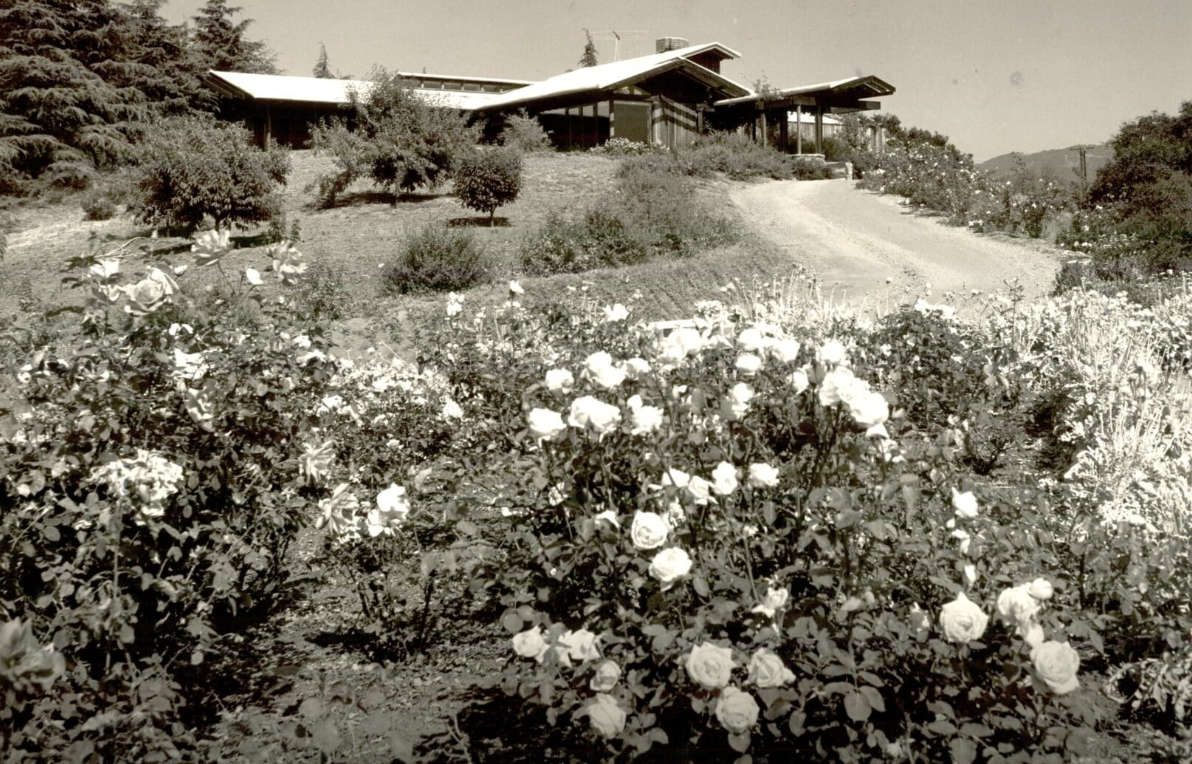
The Clarence H. Wyle House stands at 1064 Rancho Drive, Ojai, California 93023, on a hilltop above the Ojai Valley. Older local writing sometimes spells it Wylie. Harris received the commission in 1946 from Mr. and Mrs. Clarence Wyle, and the house was completed in 1948. The builder was Martin Davidson.
The plan is a pinwheel. Four wings reach out from the center of the house into the landscape, so each room gets its own view of the valley, and the major rooms have glass on three sides. USModernist describes it as a pinwheel-plan hillside house, as easy looking as a ranch house but a virtual textbook of wood detailing.
The roof is the signature. Many gables keep an absolutely level fascia line over a uniform structural system, and Harris left the rafters exposed instead of boxing in the eaves. He said he liked not having the boxed-in eaves he usually drew with a hipped roof, and by using rafters two inches deeper where they extend, he made the projection read as bold and intentional, never as a roof that had been blown off in a storm.
Inside, the living room has a built-in sofa, an inglenook, and a warming fireplace, with built-in bookcases that keep the great room informal. The master bedroom has a brick fireplace that recreates a smaller, more intimate room within the plan. One gabled wing forms a porte cochere that reaches to the drive, with exposed roof construction overhead and a rock wall with a built-in bench below. Local historians read that detail as a clear homage to the Greene brothers, which closes the loop with Casa Barranca.
The paper trail is unusually complete. The Huntington Library holds fifteen black-and-white negatives of its exterior and interior by the photographer Maynard L. Parker. House & Home published it in January 1953, the American Institute of Architects featured it in its 1957 centennial volume, and Lisa Germany's monograph on Harris, published by the University of California Press in 2000, covers it. Attribution is the hard part for most architectural houses in this valley, and this one has it documented.
“Wood, swells, burns and rots. It is as variable, unpredictable and unreliable as the human creature it shelters or warms.”
Harwell Hamilton Harris, California Arts and Architecture, May 1939
How do Harris and Walker compare on Rancho Drive?
Rodney Walker built his own steel and glass house at 1049 Rancho Drive in 1958, ten years after the Wyle House was completed at 1064. Same road, same hilltop idea, different material. Harris built in wood and shows you the joinery. Walker built in steel and shows you the glass, with a plan and a roof both drawn from the equilateral triangle. The Rodney Walker houses of Ojai covers his eight documented Ojai projects between 1956 and 1962, and reading that guide beside this one lets you see a decade of valley modernism without leaving one street.
That contrast is useful when you shop. A wood house from 1948 and a steel house from 1958 ask different things of an owner, and a Greene-inflected gable is a different object from a glass box. The valley holds several other modern vocabularies as well: Neutra's Moore House, Cliff May's ranch houses across Ventura County, and Zelma Wilson's work at Meditation Mount. For the earlier eras that came before modernism, why Ojai looks Spanish and the Perkins-Baker Residence explain how the valley's building traditions changed.
A confirmed Harris or Walker gets searched for by name from Los Angeles, San Francisco, and outside California, a very different pool from the one shopping a typical Ojai listing. That is why Debbie Pisaro treats attribution as part of the price.
What should you check before buying a mid century modern house in Ojai?
Start with attribution and the original drawings. Ask for the permit history and what has changed since the builder handed over the keys, because a house that has lost its eaves, glass, or plan has lost much of what made it worth finding.
Then ask about the material. A wood house with exposed rafters and glass on three sides carries real maintenance and wildfire questions in the Ojai Valley, and Harris's own line about wood swelling, burning, and rotting is a fair summary of the homework. Ask how the roof, eaves, and glazing have been treated, and what a fire-safety review would require.
After the structure, check the land and the services. Ojai water rights and wells matter on hillside lots, and the Ojai tree ordinance governs which oaks you can touch while you restore a house in an oak landscape. Then check whether any designation applies. A local landmark designation for the Wyle House could not be confirmed, and the guide to historic homes in Ojai explains the landmark and Mills Act process if you are weighing one.
Pricing follows the same method Debbie Pisaro uses on any one-of-a-kind architectural home in California: attribution, intactness, land, and a buyer pool that reaches past the county line. A house like this does not sell fast. It sells to the right person.
How should an owner of a Harris-era house think about attribution?
If you own a house you suspect is an architect's work, the research comes before the marketing. Start with the county assessor record and the original permit, then the Ojai Valley Museum, the USModernist archive, and library photograph collections. A confirmed attribution widens the buyer pool, which changes how the house is presented and who sees it first.
This is the part of the work Debbie Pisaro enjoys most, and it is what an Ojai realtor should do for a seller of an architectural home. The research happens before the photography, not after, and the story is written into the record before a sign goes up. If you want help finding out who designed your house, send the address and what you know to Debbie Pisaro, and she will tell you what she finds, whether or not you are selling.
A note on what this guide is. Debbie Pisaro is not the listing agent for 1064 Rancho Drive, and the house is not offered for sale here. She represents buyers on architectural homes across California, regardless of who holds a given listing, alongside her own listed and off-market inventory.
Who is the right Ojai realtor for an architectural house?
Look for an agent who can recognize the house, research its attribution, and market it beyond Ventura County. Debbie Pisaro is a 24-year veteran, founder of Coastline 840, and an Inman Luxury Leader, representing buyers and sellers across the Ojai Valley and the surrounding neighborhoods. Many of the homes she sells never reach the open market. Her practice is statewide, so the same research follows a house from the architectural homes guide to the valley and back. You can read how she works as an Ojai realtor before you reach out, or start with the neighborhood guide and the pages for buyers and sellers.
If you want a Harris, a Walker, or the house nobody has identified yet, tell your Ojai realtor what you are looking for and let the research do the finding.
My Take
Where I land on the Clarence H. Wyle House
What struck me first was the street. Rancho Drive holds this 1948 Harris house at 1064 and Rodney Walker's own 1958 steel and glass house at 1049, both chasing the same hilltop. One road, two architects, ten years apart. I don't know many streets in California that teach modernism that fast.
The house itself gives every room its own piece of the valley. Four wings pinwheel out from the middle, the main rooms have glass on three sides, and the gables hold one level line. Harris made the rafters two inches deeper where they run past the walls, just so the overhang would read as a decision. Then come the warm parts: an inglenook, a built-in sofa, a brick fireplace in the bedroom.
I picture someone who'd rather read by the fire than throw a party. Someone who knows Harris by name, or will after a weekend with Lisa Germany's book. A buyer who wants a glass box is really shopping for a Walker.
Now the honest part. It's a wood house from 1948 with exposed rafters and a lot of glass on an Ojai hilltop, and Harris himself said wood swells, burns and rots. So the homework is real: the roof and eaves, a fire-safety review, and what's changed since the builder handed over the keys. I'd check landmark status with both the city and the county, too. That's work I do before anyone falls in love, not after.
Bottom line: this is one of the few houses in the valley with its story already written down, from the Huntington negatives to House & Home in 1953. That paper trail is worth something. If a house like this ever comes up, I want to be the one who tells you first.
Common questions about Ojai mid century modern homes
What are the best Ojai mid century modern homes for sale?
The best ones are architect-designed houses from the late 1940s through the early 1960s, and many change hands quietly. Names to know are Harwell Hamilton Harris, Rodney Walker, Richard Neutra, and Cliff May. Debbie Pisaro researches attribution, plans, and permit history before a buyer commits, because the architect decides who sees the house.
Who designed the Wyle House in Ojai?
Harwell Hamilton Harris designed the Clarence H. Wyle House, which he was commissioned to do in 1946 and which was completed in 1948. Martin Davidson was the builder. Harris trained in Los Angeles around Rudolph Schindler and Richard Neutra, and he is also remembered for championing the Greene brothers when few architects remembered them.
Where is the Wyle House?
The Clarence H. Wyle House is at 1064 Rancho Drive, Ojai, California 93023, on a hilltop above the Ojai Valley. It is sometimes spelled Wylie in older local writing. Rodney Walker's own house is at 1049 Rancho Drive, so one street holds a 1948 Harris house and a 1958 Walker house.
Is the Wyle House for sale?
No. It is a private residence and it is not offered for sale in this article. Debbie Pisaro is not the listing agent for 1064 Rancho Drive. She represents buyers on architectural homes across California regardless of who holds a given listing, and she can tell you about mid century houses before they are listed.
Is the Wyle House a landmark?
A local landmark designation could not be confirmed for it. Ojai runs a Historic Preservation Commission with a numbered landmark program, and some valley addresses sit in county territory under a separate authority. Do not assume a mid century house is protected. Check its status with the city and the county before you buy or alter one.
What makes a Harris house different?
Harris built in wood and let the structure show. At the Wyle House the many gables hold one level fascia line over a uniform structural system, the rafters are exposed, and every joint was detailed by Harris himself. The result looks as easy as a ranch house but reads as a lesson in wood detailing.
How do I find who designed my Ojai house?
Start with the Ventura County assessor record and the original building permit, which usually names the designer or builder. Then check the Ojai Valley Museum, the USModernist archive, and library photograph collections. Debbie Pisaro will research an address you send her, whether or not you are selling, and tell you what she finds.
Do Ojai architectural homes sell quietly?
Many do. Attributed architectural houses in the valley tend to find their buyers through word of mouth, the architect's name, and private lists more than through a public listing. Many of the homes Debbie Pisaro sells never reach the open market, so telling her what you want is often the fastest way to hear about one.
Who is a good full-service real estate agent in Ojai?
Debbie Pisaro of Coastline 840 represents buyers and sellers across the Ojai Valley and the surrounding neighborhoods, with a focus on architectural and historic homes. She is a 24-year veteran and an Inman Luxury Leader. Her practice runs from Los Angeles through Ventura County, so one agent can follow a house across California.
Debbie Pisaro is a 24-year veteran, founder of Coastline 840, and an Inman Luxury Leader, representing buyers and sellers across the Ojai Valley and the surrounding neighborhoods. Many of the homes she sells never reach the open market. She is an architectural homes specialist working from Los Angeles to Ojai and across California, and she writes about the valley at Just Ojai. Coastline 840 is a DBA of Side, Inc., CA DRE #02014153. Powered by Side: #1 California-based brokerage, No. 9 in the nation.
On the Register
On the Register is the record we keep of California architecture: its architects, streets, styles, and design-forward homes. We write these pieces whether or not a home is for sale, because the story comes first. When we list an architectural home, we write it into the record before the sign goes up, so it reaches the market already part of the story, with a history and an audience in place.
© 2026 Debbie Pisaro, Coastline 840 · ontheregister.com