The Perkins-Baker Residence: an Edwards and Plunkett Tudor in Ojai
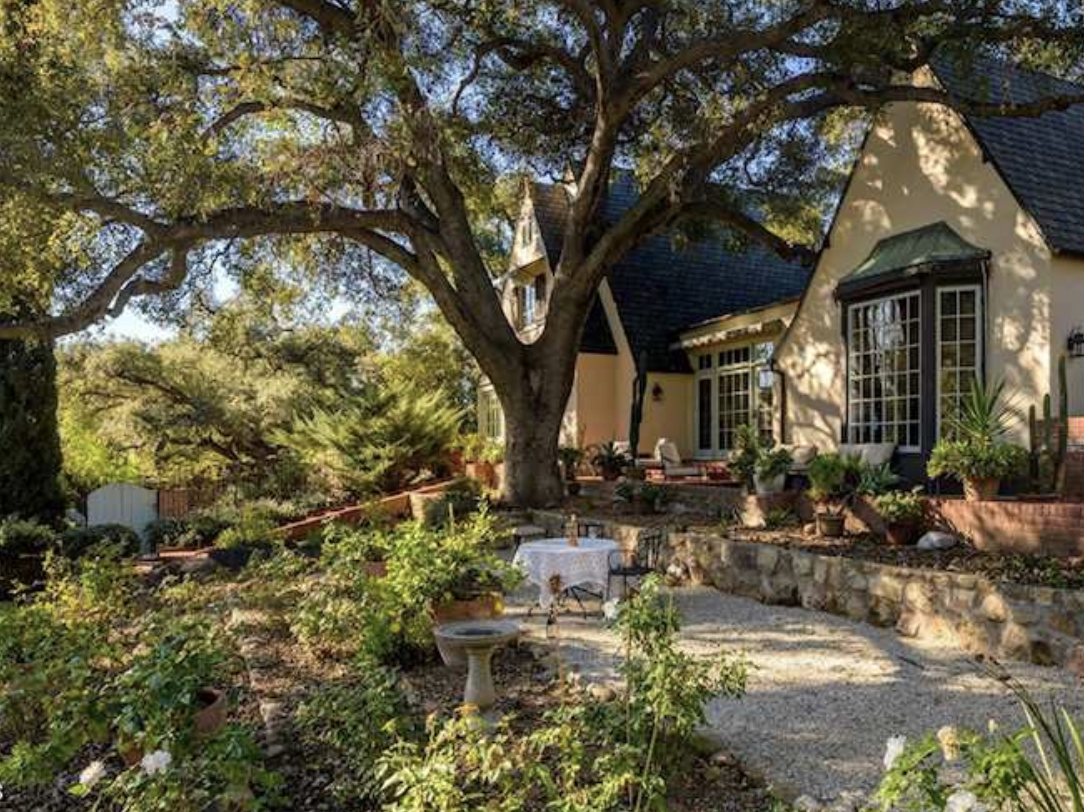
Perkins-Baker Residence at a glance
What makes the Perkins-Baker Residence one of Ojai's historic homes?
Among historic homes for sale in Ojai, few carry formal status. The Perkins-Baker Residence at 1104 Foothill Road, Ojai, CA 93023, does. The City Council made it City of Ojai Historic Landmark No. 28 in 2020. William A. Edwards of the Santa Barbara firm Edwards and Plunkett designed the 1920s Tudor Revival house, and Lockwood de Forest laid out its grounds.
Perkins-Baker Residence · 1104 Foothill Road, Ojai, CA 93023 · City of Ojai Historic Landmark No. 28 · Edwards and Plunkett · 1925
Ojai Architecture
A Santa Barbara firm known for Spanish Revival, a Tudor house on Foothill Road, and a landmark number that changes what the next owner can do.
If you are weighing historic homes for sale in Ojai, start with one question about any house you are shown: is "historic" a description or a designation? At 1104 Foothill Road it is a designation. That single fact decides who reviews your remodel, what you may pay in property tax, and how the house should be presented the day it trades.
It is also the first question a good Ojai realtor should answer before you write an offer. Plenty of Ojai houses are old and handsome. Very few hold a landmark number.
The house at 1104 Foothill Road
The City of Ojai lists the property as the Perkins-Baker Residence, a Tudor style main house and guest cottage. The City Council designated it Historic Landmark No. 28 by Resolution No. 20-07 on February 11, 2020, and it appears under that number on the City of Ojai historic landmark list. At one point the house was also marketed under the name Foothill Farms, so you may see it filed that way.
The property covers roughly 1.16 acres inside Ojai city limits, a short walk from downtown and from the Pratt Trail. It is three buildings: a main residence with three bedrooms and an office, a one bedroom guest cottage, and a detached studio. Inside the main house you find cathedral ceilings, exposed beams, oak floors, and period detail that was restored rather than stripped. Outside there is a pool, orchard trees, gardens, and terraces facing the Topatopa Mountains.
Records give the house a 1925 construction date. It has changed hands more than once since the city designated it. Designation did not stall those sales, and the marketing that followed the house led with its landmark number and its architect rather than burying them.
Debbie Pisaro is not the listing agent for 1104 Foothill Road. Debbie represents buyers on architectural homes across California, regardless of who holds a given listing, the same standing practice whether a home is on or off market.
Ojai Watch
Know Ojai before everyone else does.
A landmark trades, a house sells for a number that raises eyebrows, a rule changes at City Hall. Join the list for everything worth knowing about Ojai.
Join the list or call (310) 362-6429Who was William A. Edwards?
William Albert Edwards was a Santa Barbara architect, born there in 1888, who founded the firm Edwards and Plunkett with James Joseph Plunkett in 1925. The partnership ran until 1940 and became one of the leading practitioners of Spanish Colonial Revival in Santa Barbara, best known for the Arlington Theatre on State Street.
Edwards trained at Berkeley and at the University of Pennsylvania, took his architecture degree in 1912, and opened his own office back in Santa Barbara in 1919. Their timing turned out to matter. On the day of the 1925 Santa Barbara earthquake, the two partners got a permit to tour the damage, and the rebuilding that followed brought them a steady run of commissions.
Their work reads like a walking tour of Santa Barbara: the Medical Arts Building on Chapala Street in 1926, the Santa Barbara Woman's Club in 1927, the Arlington Theatre from 1929 to 1931, and later the original terminal at the Santa Barbara airport. They also designed houses in Montecito and Hope Ranch. Edwards left for a government job in 1940, formed Edwards and Wade after the war, retired in 1950, and died in 1976.
If you want the wider story of the style the firm is known for, Coastline 840 keeps a guide to Spanish Colonial Revival homes in California.
A Tudor house from a Spanish Revival firm
That is what makes the Perkins-Baker Residence worth a second look. A firm whose name is tied to red tile, plaster, and wrought iron drew an English Tudor Revival house, and did it in a valley that was busy becoming Spanish.
Ojai's own turn toward Spain came from the top. Edward Drummond Libbey paid for the Mission Revival arcade and the post office tower downtown, dedicated in 1917, and the look spread from there. You can read how that happened in why Ojai looks Spanish. Against that backdrop, a Tudor from a Santa Barbara Spanish Revival office was a deliberate choice, and it gives the property a story of its own.
For you as a buyer, the style matters in a practical way too. The character defining features of a designated house are what the city protects, and on a Tudor those tend to be the roof forms, the windows, and the interior woodwork. Know which of them the city named before you plan to change any of them.
The Lockwood de Forest garden
The original landscape was laid out by Lockwood de Forest, the Santa Barbara landscape architect whose gardens helped shape Montecito. A Santa Barbara architect and a Santa Barbara landscape designer on one Ojai property is an unusual pairing here.
On an Ojai property the grounds carry their own rules. Protected trees on the site fall under the city's tree rules, which Debbie walks through in the Ojai tree ordinance. Whether any part of the garden is itself a named feature of the landmark is a question for the resolution, so read it before you draw a new driveway, a pool house, or a lawn where an oak has stood for decades.
What does City of Ojai Historic Landmark No. 28 mean for a buyer?
City of Ojai Historic Landmark No. 28 means the Perkins-Baker Residence falls under Ojai's own preservation ordinance, Municipal Code Title 4, Chapter 8. Work that touches the house's character defining features needs a Major Work Permit and a public hearing, while work that leaves them alone moves through a Minor Work Permit, approved administratively.
The city's program is young. It was established by Ordinance 893 in April 2019, and a seven member Historic Preservation Commission reviews nominations and permits, while only the City Council can designate. That timing is why the Perkins-Baker designation sits so close to the one before it: Landmark No. 27, also on Foothill Road at 520, was approved by Resolution No. 19-40 the year before.
Jurisdiction is the part most buyers miss. Because 1104 Foothill Road is inside the city, the Ventura County Cultural Heritage Board does not review it. Cross the city line into the East End, Meiners Oaks, or Mira Monte and the county's program applies instead, with a different board, a different permit, and a different timeline. Debbie lays out both rulebooks side by side in historic homes in Ojai, landmarks and the Mills Act.
Before it's public
See Ojai's landmark houses before they reach the open market.
Designated houses in this valley rarely go public first. Get on the list for what is available off-market.
View off-market homesHow does the Mills Act work on an Ojai landmark?
The Mills Act lets the owner of a designated Ojai landmark sign a ten year, self renewing contract with the city that lowers the county property tax assessment in exchange for maintaining and restoring the house's historic features. In Ojai, only a designated city landmark such as 1104 Foothill Road can apply to the city's program.
The terms Debbie tracks on Ojai contracts: a filing fee of $1,690, a right for the city to inspect the property each year, and a penalty of 12.5 percent of assessed value for cancelling early. The contract is recorded against the property and binds the next owner, so a buyer inherits both the lower assessment and the upkeep obligations.
Eligibility is not the same as a contract on file. The marketing that followed this house described it as qualifying for Mills Act benefits, which suggests a new owner would apply rather than inherit an existing agreement. Ask for the recorded documents before you write an offer. The seller side of the same question is covered in selling a Mills Act home in Los Feliz, where the mechanics are close cousins, and the statewide picture is in how California protects historic architectural homes.
If you own a designated house in Ojai
Put the landmark number, the resolution date, and the architect's name in the first line of the listing, where a searcher will actually see them. Buyers who search for a named house or a named architect are the buyers who will pay for the history, and they cannot find a house the listing never names.
Before you list, pull three documents: the landmark resolution, the list of character defining features, and any Mills Act contract recorded against the parcel. A house with a landmark number and a tax contract is a different product from a pretty 1920s house with no paperwork. That is the preparation Debbie does before an architectural house in the valley goes public, and it is laid out further on choosing the best real estate agent in Ojai.
Foothill Road's other landmarks
Foothill Road carries more of the valley's recognized architecture than its quiet frontage suggests. Farther up the road is Casa Barranca, the Greene and Greene Pratt House, built in 1909 at 1330 North Foothill Road and listed on the National Register. On North Foothill you will also find Richard Neutra's Moore House, which took an AIA First Honor Award in 1954. The Pratt Trail near 1104 shares its name with the family behind that Greene and Greene house, and just below, George Washington Smith's Spanish houses in the Arbolada fill out the picture.
For every named house in the valley on one page, start with the Ojai architectural homes map.
Where this house sits in California
Ojai's architectural story is usually told as a Los Angeles story, with Neutra, Paul R. Williams, and Rodney Walker driving up from the city. The Perkins-Baker Residence is a reminder that the valley also looks north, over the Casitas Pass, to the Santa Barbara architects and landscape designers who shaped Montecito.
Debbie Pisaro works that whole stretch of coast, from Los Angeles to Santa Barbara and inland to Ojai. She founded Coastline 840 as a boutique California practice, and the reasons are in why she built Coastline 840 and why boutique real estate teams outperform the big offices. The California architects behind houses like this one are indexed in the California architects guide.
Common questions about historic homes in Ojai
Are there historic or adobe homes for sale in Ojai, CA?
Yes, but designated ones are scarce. Most Ojai houses called historic are old rather than designated, and only a city landmark such as the Perkins-Baker Residence at 1104 Foothill Road can apply for the city's Mills Act program. True adobes are rarer still. Ask for the landmark resolution and any recorded contract before you pay for the word.
Where is the Perkins-Baker Residence?
The Perkins-Baker Residence is at 1104 Foothill Road, Ojai, CA 93023, inside Ojai city limits and close to downtown and the Pratt Trail. It sits on roughly 1.16 acres with a main house, a guest cottage, and a detached studio. It is a private residence, so you see it from the road, not the grounds.
Who designed the Perkins-Baker Residence?
William A. Edwards of the Santa Barbara firm Edwards and Plunkett designed the Perkins-Baker Residence, a Tudor Revival house with a 1925 construction date. The original landscape was by Lockwood de Forest. Edwards and Plunkett are best known for Spanish Colonial Revival work, including the Arlington Theatre in Santa Barbara, which makes this Tudor house unusual.
When was the Perkins-Baker Residence designated?
The Ojai City Council designated the Perkins-Baker Residence City of Ojai Historic Landmark No. 28 by Resolution No. 20-07 on February 11, 2020. The designation covers the Tudor style residence and its guest cottage. It came less than a year after the city's own landmark ordinance took effect in April 2019.
How does the Mills Act affect home value?
It lowers the property tax bill, and buyers price that in. Under a Mills Act contract the assessor values the property by its income rather than its market sale price, so the assessment usually falls. The contract binds the next owner, along with its upkeep duties. In Ojai, only a designated city landmark is eligible.
What are the tax benefits of owning a historic home in California?
The main one is the Mills Act, which lets California cities and counties sign ten year, self renewing contracts that reduce property taxes on designated historic properties in exchange for preservation. Inside Ojai the city runs it, and unincorporated areas fall under Ventura County. Landmark status alone lowers nothing; the recorded contract does.
Can you remodel an Ojai landmark?
Yes, with the right permit. Work that touches a landmark's character defining features needs a Major Work Permit and a public hearing before the Historic Preservation Commission. Work that leaves those features alone needs only a Minor Work Permit, approved administratively. Interior updates usually move faster than any change to the street facing elevation.
Which architectural homes in Ojai matter most?
Ojai's architect designed houses run from Greene and Greene's Casa Barranca and Richard Neutra's Moore House to Rodney Walker's postwar work and the Edwards and Plunkett Tudor at 1104 Foothill Road. Only a few reach the market in any given stretch, and many trade quietly. Start with the Ojai architectural homes map.
Who is a good full-service real estate agent in Ojai?
Look for an agent who handles the whole valley and still checks designation, jurisdiction, and Mills Act status before writing a word of marketing. Debbie Pisaro, a California real estate agent with Coastline 840 and an Inman Luxury Leader, represents buyers and sellers across Ojai, from downtown to the East End and Meiners Oaks.
Old houses in this valley are not interchangeable. Two on the same road can sit under different rules, and only one may come with a tax contract attached. Sorting that out is what any Ojai realtor worth hiring does first. Debbie Pisaro is a 24-year veteran, founder of Coastline 840, and an Inman Luxury Leader, representing buyers and sellers across Ojai and the surrounding neighborhoods. Many of the homes she sells never reach the open market.
For buyers and sellers
Own a landmark in Ojai, or want one?
Debbie Pisaro of Coastline 840, Ojai. · DRE #01369110
Reach Debbie(310) 362-6429 · debbie@coastline840.com · Coastline 840 · 160 Glendale Blvd, Los Angeles, CA 90026
Debbie Pisaro is a 24-year veteran of the Los Angeles and Ojai architectural market, a California real estate agent, DRE #01369110, the founder of Coastline 840, and an Inman Luxury Leader. She specializes in architectural and historic homes, including Mills Act and landmark properties, from Los Angeles to Santa Barbara and the Ojai Valley. Many of the homes she sells never reach the open market. Coastline 840 is a boutique California practice and a DBA of Side, Inc., CA DRE #02014153, her responsible broker. More about Debbie and Just Ojai.
Debbie Pisaro · DRE #01369110 · Coastline 840 · Side, Inc. DRE #02014153 · (310) 362-6429
On the Register
On the Register is the record we keep of California architecture: its architects, streets, styles, and design-forward homes. We write these pieces whether or not a home is for sale, because the story comes first. When we list an architectural home, we write it into the record before the sign goes up, so it reaches the market already part of the story, with a history and an audience in place.
© 2026 Debbie Pisaro, Coastline 840 · ontheregister.com