George Washington Smith in Ojai: the Arbolada spec houses
Powered by Side: #1 California-based brokerage, No. 9 in the nation.
The Arbolada Smith houses at a glance
Where are the Spanish Colonial Revival homes in Ojai?
If you want Spanish Colonial Revival homes for sale in Ojai, start in the Arbolada. George Washington Smith designed the spec houses Edward Libbey built there in the early 1920s, at 701 Foothill Road, 715 El Toro Road, and 410 Tico Road, and the City of Ojai has designated each one a landmark.
I'm Debbie Pisaro, an Ojai realtor, and when a buyer tells me they want a real Spanish Colonial Revival house in Ojai, one built in the 1920s rather than dressed up in stucco and red tile decades later, I send them to a handful of addresses in the Arbolada first. They are the houses the Ojai look was built to sell.
Why did Edward Libbey build spec houses in the Arbolada?
Edward Drummond Libbey, the Toledo glass magnate who reshaped downtown Ojai, began buying land in the valley in 1916. By the spring of 1917 the town of Nordhoff had become Ojai, and the Arcade and the post office tower he paid for were standing on the main street. Both were designed by the San Diego firm of Mead and Requa, and the tower takes its shape from a church campanile in Havana. The town celebrated the new look on Ojai Day, April 7, 1917, with Libbey on the program.
The Arbolada came next. Libbey laid it out in the early 1920s as one of the valley's first planned neighborhoods, on the oak-covered slope north of downtown. A subdivision of oak-shaded lots is hard to sell from a map, so Libbey built model houses first and hired the architect then defining the style in California: George Washington Smith of Santa Barbara.
The City of Ojai's landmark list keeps the lettering Libbey's project gave them: Spec House A, Spec House B, and Spec House C. Architectural historians also call them the Maravilla Company houses, after the Maravilla Improvement Company, formed to develop and sell the Arbolada tract. The landmark list records the Arbolada's sales office at 121 East Ojai Avenue, built by that company, and the archway entrance to the neighborhood at 1005 Foothill Road, which Libbey built with the contractor F.C. Fassel. The longer story of how the whole town took on this look is in why Ojai looks Spanish.
Which Ojai houses did George Washington Smith design?
Three houses in the Arbolada are credited to George Washington Smith on the City of Ojai's list of historic landmarks, and all three were built as Libbey's spec houses. Each is a designated City landmark, and each sits on a different street of the Arbolada.
Spec House A, 701 Foothill Road
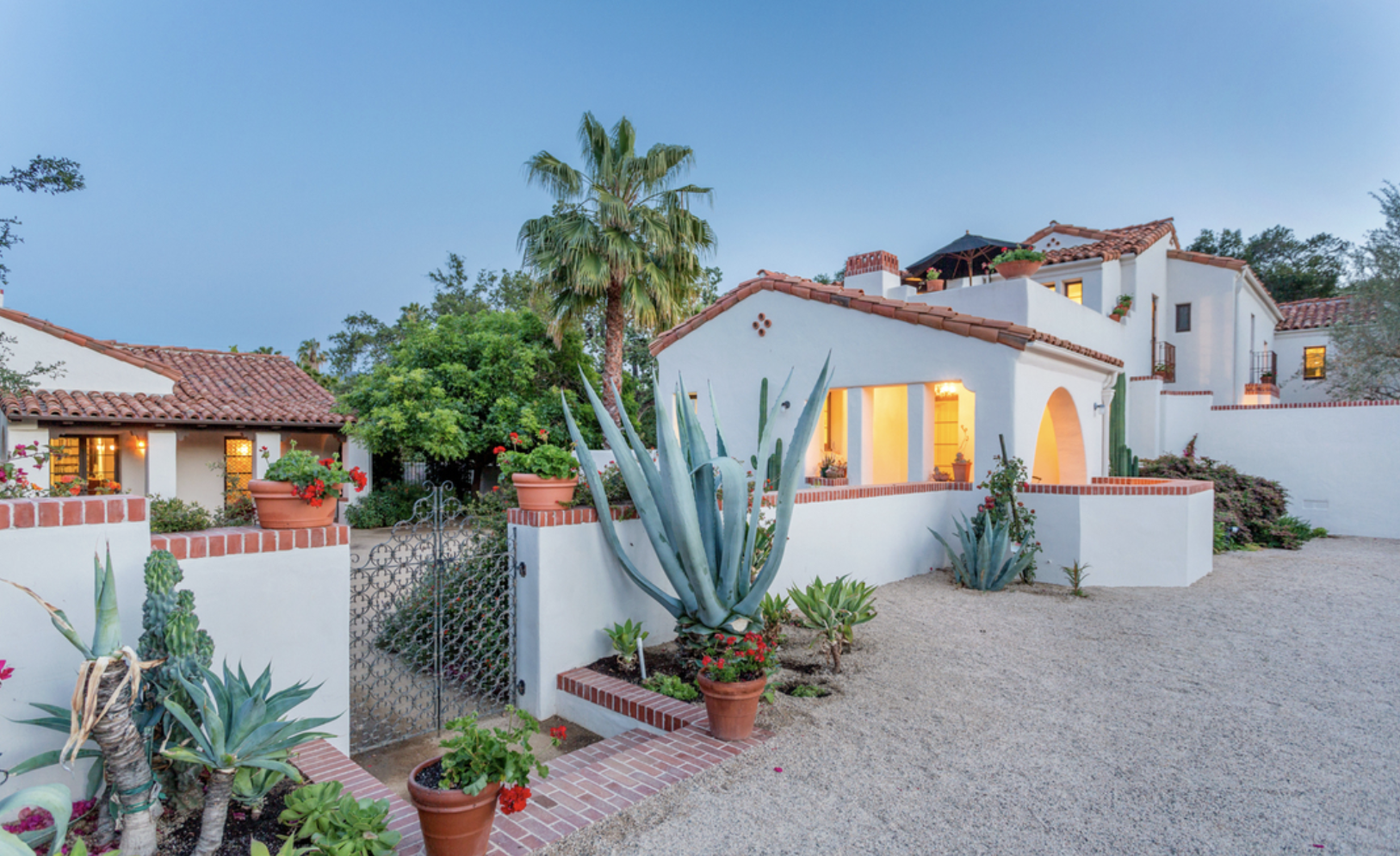
The City of Ojai designated 701 Foothill Road as Landmark No. 16 by Council Resolution 08-57 on December 9, 2008. The marketing material that has followed the house describes it as completed between 1921 and 1922, a Spanish Colonial Revival estate with a detached artist's studio and mature grounds. It sits at the corner of Foothill Road and El Toro Road, on the Foothill stretch of the Arbolada, not far from the Libbey gateway.
Spec House B, 715 El Toro Road
715 El Toro Road is Landmark No. 20, designated by Council Resolution 11-34 on June 28, 2011. The marketing material that has followed it calls the house Casa El Toro and describes a renovation by the architect Kevin Clark that nearly doubled the original footprint. That makes it the one to study if you want to understand how far a landmarked Smith house can be extended and still read as a Smith house.
Spec House C, 410 Tico Road
410 Tico Road is Landmark No. 15, designated by Council Resolution 08-39 on August 26, 2008, the earliest of the three designations. Its listing history dates the main residence to 1924 and describes the rural Andalusian influence that Smith carried over from his Montecito work. Tico Road is the quieter, deeper end of the Arbolada.
Debbie Pisaro is not the listing agent for 701 Foothill Road, 715 El Toro Road, or 410 Tico Road. Debbie represents buyers on architectural homes across California, regardless of who holds a given listing, the same standing practice whether a home is on or off market.
How do you recognize a George Washington Smith house?
Look for restraint. Smith built his reputation on plain, thick-looking white walls, low tile roofs, deep-set windows, and rooms arranged around a garden or courtyard rather than toward the street. He took the model from the farmhouses he saw in Andalusia on a trip to Spain in 1914, and his own first house in Montecito, El Hogar of 1916, was built on that idea. What a Smith house leaves out matters as much as what it puts in: there is very little applied ornament, and the decoration that is there, tile, ironwork, a carved door, is concentrated where the hand and eye land.
That restraint is also what makes later houses in the style easy to tell apart. A 1990s house with Spanish details tends to pile the details on. A Smith house lets the wall do the work.
What does a landmark designation mean for an Ojai owner?
A City of Ojai landmark designation is a recorded resolution, and it follows the property to every owner. It matters in two ways. First, exterior changes get reviewed, so you should read the resolution before you plan an addition or a window replacement. Second, a designated property can be eligible for a Mills Act contract, which can lower property taxes in exchange for a commitment to maintain the house. How the state framework works is laid out in how California protects historic architectural homes.
Whether a contract is in place on a specific house is a question for the City file, not for a marketing brochure. If you are weighing one of these houses, ask for the designation resolution and any Mills Act agreement before you write an offer. Debbie asks for both on every historic property she works on, and the same discipline applies to historic homes in Ojai generally.
It is also worth asking whether drawings survive. Most of Smith's original sketches, drawings, and much of his correspondence are held in the Architecture and Design Collection at the University of California, Santa Barbara, and the finding aid for the Smith papers is public. A buyer who can match a house to its original drawings knows what is original and what came later, which is the first question any landmark review will ask.
Where does George Washington Smith fit in California?
Smith was born in 1876 in East Liberty, Pennsylvania, studied architecture at Harvard without finishing, and spent years in Paris as a painter at the Académie Julian before he arrived in Montecito around 1916. The house he built for himself drew so much attention that he gave up painting and practiced architecture full time from Santa Barbara until his death in 1930. Lutah Maria Riggs joined his office in 1921.
His best-known work is Casa del Herrero in Montecito, built from 1922 to 1925 for George Steedman, an amateur metalsmith. The name, the house of the blacksmith, is a play on both men, and the house was designated a National Historic Landmark on January 16, 2009. He also rebuilt the Lobero Theatre in Santa Barbara to his own design in 1924. Ojai holds a small group of his houses that Libbey commissioned in a single burst, and the statewide picture of the style is in my guide to Spanish Colonial Revival homes in California.
Debbie Pisaro works these houses as part of a statewide California practice through Coastline 840, from Ojai and Montecito to the architectural neighborhoods of Los Angeles, and the buyers who chase Smith tend to follow the architect from town to town. She has written about why she built Coastline 840, and about why boutique teams outperform the big-box firms. The same thread runs through her guide to California's architects and their houses.
What else on Foothill Road and nearby is worth knowing?
Foothill Road is one of the densest runs of Ojai architecture, which is why I keep returning to it. Charles and Henry Greene's Casa Barranca is farther up the road, the Tudor-style Perkins-Baker Residence is on Foothill too, and across the valley in Meiners Oaks the Spanish-Moorish Acacia Mansion shows a different hand working in a related idiom. For the wider map, see my guide to architectural homes for sale in Ojai, California, and the earlier Neutra Moore House for the modernist end of the range.
How do you buy or sell a Smith house in Ojai?
Quietly, and with the City file in hand. A landmarked Smith house is a small market of its own, and the Ojai realtor you choose should know the designation resolution as well as the comps. Debbie Pisaro is a 24-year veteran, founder of Coastline 840, and an Inman Luxury Leader, representing buyers and sellers across Ojai and the surrounding neighborhoods. Many of the homes she sells never reach the open market.
For a seller, the work starts before the house is shown: the resolution, any Mills Act agreement, the permit history, and whatever drawings can be found, assembled so a buyer can see what is original. For a buyer, it is the same file read from the other side. Debbie is an architectural homes specialist, and her page on choosing the best real estate agent in Ojai covers what to ask before you hire anyone. For the rest of the valley, start at Just Ojai.
How I read the Arbolada Spec House A
What struck me most is that the studio at 701 Foothill Road is its own building. The marketing material that has followed the house describes a detached artist's studio, and that one choice changes how the whole place lives: the work happens across the garden, not down the hall, and the main house gets to stay a house.
That's the Smith idea in small. He built for the garden and the walk between rooms as much as for the rooms themselves, and he kept the walls plain so the light and the planting could do the work. On a corner lot at Foothill and El Toro, with grounds that have had a century to grow in, that restraint reads as confidence.
I picture someone who makes things living here. A painter, a writer, a couple where one of them needs a door to close at the end of the day. Smith was a painter before he was an architect, so I like the idea of the studio being used the way he'd have used it.
The honest part is the paperwork, and it's homework I'd do before anyone fell in love. It's Landmark No. 16, so any change to the outside goes through review. I'd read Resolution 08-57, ask for any Mills Act agreement, and pull the permit history on the studio before writing an offer. A house this old has been touched over the years, and the file tells you where.
Bottom line: this is the one I'd show first to a buyer who wants the Arbolada at its most complete. It's the spec house that still has everything Libbey was selling: the architect, the garden, and room to work.
Frequently asked questions
Where can I find Spanish Colonial Revival homes for sale in Ojai?
Start in the Arbolada, the oak-shaded neighborhood north of downtown that Edward Libbey laid out in the early 1920s. George Washington Smith's landmarked spec houses are on Foothill Road, El Toro Road, and Tico Road, and many other Arbolada homes carry the same Spanish Colonial Revival influence. The best of them often trade privately.
Where are Smith's Ojai houses?
All three are in the Arbolada, just north of downtown Ojai, California 93023. Spec House A is at 701 Foothill Road, at the corner of El Toro Road. Spec House B is at 715 El Toro Road. Spec House C is at 410 Tico Road, at the quieter, deeper end of the neighborhood.
Which Ojai houses did Smith design?
The City of Ojai's landmark list credits George Washington Smith with three Arbolada spec houses commissioned by Edward Libbey in the early 1920s: 701 Foothill Road, Landmark No. 16; 715 El Toro Road, Landmark No. 20; and 410 Tico Road, Landmark No. 15. The three were designated in 2008 and 2011.
What is the Arbolada in Ojai?
The Arbolada is the oak-shaded neighborhood just north of downtown Ojai that Edward Libbey laid out in the early 1920s as one of the valley's first planned subdivisions. Its archway entrance stands at 1005 Foothill Road, and its lanes hold Smith's three landmarked spec houses alongside later Spanish Colonial Revival homes.
Who was Edward Libbey?
Edward Drummond Libbey, who lived from 1854 to 1925, was the Toledo glass magnate who began buying land in Ojai in 1916 and remade its downtown by 1917. He then laid out the Arbolada and hired George Washington Smith to design its first model houses, the three now known as Spec Houses A, B, and C.
Can a landmark house be expanded?
It can be, but exterior changes to a City of Ojai landmark get reviewed, so read the designation resolution before you plan an addition. Casa El Toro at 715 El Toro Road is the example to study: the marketing material that has followed it describes a renovation that nearly doubled the original footprint.
What are architectural homes for sale in Ojai, California?
Ojai's architectural homes range from Greene and Greene craftsmanship and Smith's Spanish Colonial Revival to Richard Neutra and mid-century modern work. Many are landmarked or sit in older neighborhoods like the Arbolada and the East End. Because the houses are individual, the architect, the original plans, and the landmark file matter as much as square footage.
What are historic homes for sale in Ojai, CA worth looking at?
Look first at houses with a recorded provenance: a named architect, a City or County landmark resolution, and original drawings or permit history. In Ojai that points to the Arbolada's Smith houses, Foothill Road's Tudor and Craftsman landmarks, and adobe and Spanish Revival estates. Ask for the designation file before you offer.
Who is the best real estate agent for architectural homes in Ojai?
Debbie Pisaro is a California Real Estate Salesperson, DRE #01369110, who specializes in architectural and historic homes across Ojai and Los Angeles through Coastline 840, a DBA of Side, Inc., CA DRE #02014153. She is an Inman Luxury Leader, and many of the homes she sells never reach the open market.
Does a City of Ojai landmark qualify for the Mills Act?
A designated landmark can be eligible for a Mills Act contract, which reduces property taxes in exchange for a long-term commitment to preserve the house. Whether one is in place depends on the individual property and the City's records, so ask for the designation resolution and any recorded agreement before you buy.
Written by Debbie Pisaro, Real Estate Agent, DRE #01369110, a 24-year veteran who specializes in architectural and historic homes, and an Inman Luxury Leader. Many of the homes she sells never reach the open market. More about Debbie. Coastline 840 is a boutique California practice and a DBA of Side, Inc., CA DRE #02014153, responsible broker. Powered by Side: #1 California-based brokerage, No. 9 in the nation.
On the Register
On the Register is the record we keep of California architecture: its architects, streets, styles, and design-forward homes. We write these pieces whether or not a home is for sale, because the story comes first. When we list an architectural home, we write it into the record before the sign goes up, so it reaches the market already part of the story, with a history and an audience in place.
© 2026 Debbie Pisaro, Coastline 840 · ontheregister.com