The short answer
What is the Harvey House on Grand Avenue in Ojai?
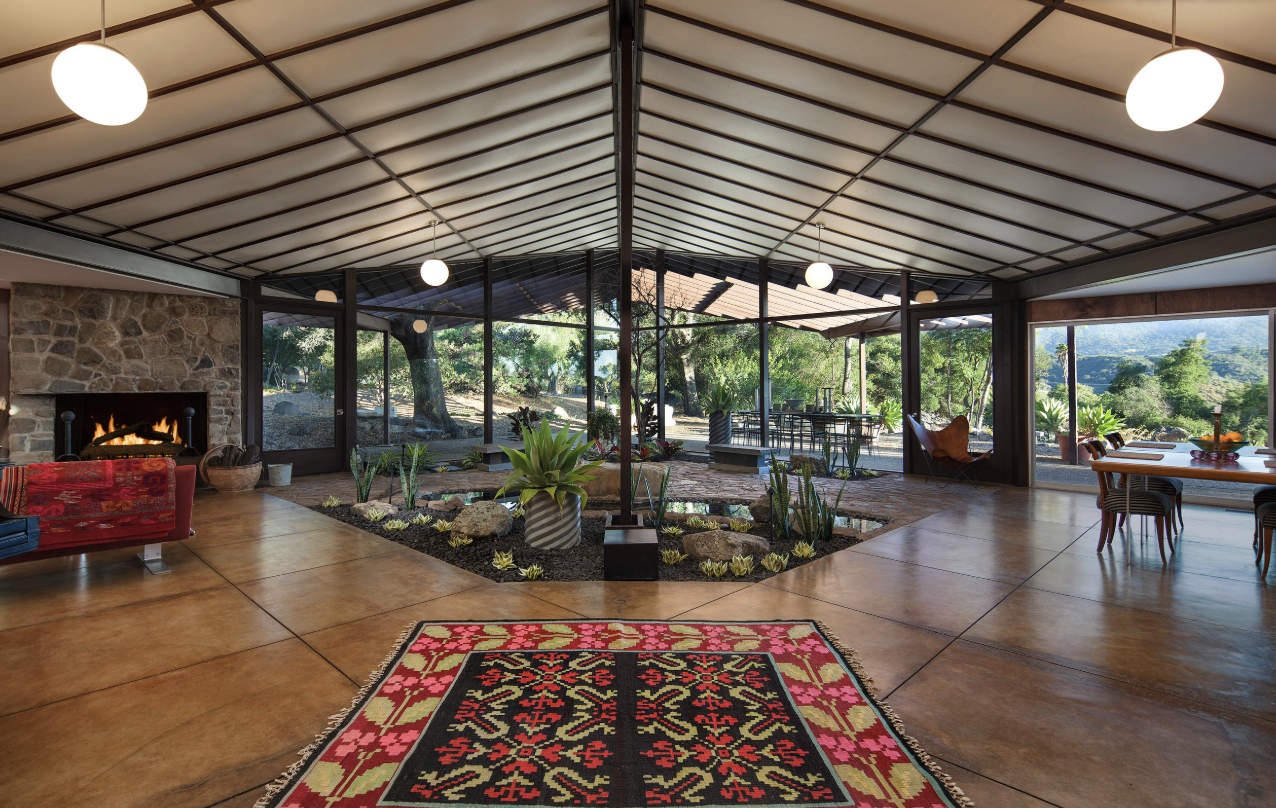
The David Harvey House is a 1959 steel and glass house at 4275 Grand Avenue in Ojai, designed by Rodney Walker for Dr. David Harvey and his family. Among Ojai mid century modern homes, it is also a family story: his daughter, Suzanne Harvey Gray, restored the house and moved back into it.
Powered by Side: #1 California-based brokerage, No. 9 in the nation.
Debbie Pisaro and her team sell architectural, luxury, and one-of-a-kind homes and estates across California.
Ojai Architecture
A Case Study designer, a doctor's family, and the daughter who came home to restore the house she grew up in.
Most houses lose their story when they change hands. The Harvey House never changed hands. Rodney Walker designed it in 1959 for a doctor's family on Grand Avenue, and when the time came to decide its future, the daughter who grew up in it chose to move back and restore it rather than sell. As an Ojai realtor who spends a lot of time with this valley's modern houses, I think it is the clearest lesson Ojai has in how to update a mid-century house without erasing it.
Who designed the Harvey House on Grand Avenue in Ojai?
Rodney Walker designed it. Walker (1910 to 1986) drew the first versions of Case Study Houses 16, 17 and 18 for Arts & Architecture magazine in the late 1940s, after a short stretch as a draftsman for Rudolph Schindler. He called himself a designer and builder rather than an architect, and he meant it: he wanted to build the houses himself.
He fell for the Ojai Valley in 1955 and moved his family here for good in 1956. Over the next six years he produced the short list of houses I cover in Rodney Walker houses in Ojai, eight documented projects in all, then gave up design work in 1965 and helped some 200 neighbors buy and reopen The Oaks Hotel downtown. The Harvey House sits in the middle of that run, a year after his own steel and glass house on Rancho Drive.
His Los Angeles houses still turn up too. My Studio City site covers a pair of them in the Rodney Walker houses on Alta Mesa Drive, which makes a useful comparison: the Los Angeles work is mostly wood, and the Ojai work moves to steel.
Dr. David Harvey's house, 1959
The client was Dr. David Harvey, and the house was built for him and his family in 1959. It was published in its day: USModernist records that it was featured in Sunset magazine and the Los Angeles Times, which put an Ojai house in front of readers across California at a time when the valley was better known for ranches and Spanish Revival than for modernism.
Ojai historian David Mason describes it as steel and glass with a prominent projecting roofline on both the front and the back. Houzz lists it at about 3,500 square feet with three bedrooms.
Grand Avenue matters to the story. Walker built twice on this road in two years: the Harvey House at 4275 Grand Avenue in 1959, and the Kurt Semel House at 4184 Grand Avenue in 1960. No other street in the valley has two documented Walker houses. Grand Avenue runs out on the east side of the valley toward the East End, where the lots are big enough for a house to open itself to the land.
Ojai architecture, monthly
The houses of this valley, one story at a time.
Debbie Pisaro writes up a Walker, a Neutra, or a house nobody has identified yet, and sends it once a month.
Get the Just Ojai letter Or call (310) 362-6429What I see in 4275 Grand Avenue
4275 Grand Avenue is a compelling example of Rodney Walker's ability to make modern architecture feel both open and grounded. The steel framing and expanses of glass create a sense of lightness, while the projecting rooflines and a massive stone fireplace give the house weight and a strong connection to its surroundings.
The interior garden further blurs the boundary between inside and out, an essential quality of California modernism.
Suzanne Harvey Gray's restoration adds another chapter to the house's history, and it raises the question every owner of a house like this eventually faces: how do you preserve the spirit of a modernist home while adapting it for contemporary life?
The daughter who came home
The house was deeded to the Harveys' daughter, Suzanne Harvey Gray. Her timing was the kind that forces a decision. She had lost both of her parents, and she had retired from a career in banking. She could sell the house she grew up in, or she could move back into it.
She moved back. That one choice is why the Harvey House reads the way it does. A buyer would have been restoring someone else's house. Gray was restoring her own childhood, and she set out to keep both Walker's design and her memories of the house as intact as she could.
How do you restore a Rodney Walker house without losing it?
You start by deciding what not to touch. Gray's renovation was the first the house had ever had, more than half a century after it was built, and she did it with Allen Construction, the Santa Barbara builder that also restored Walker's own house on Rancho Drive. USModernist credits Allen with the Harvey restoration, and Houzz carries Allen's photographs of the finished house by Jim Bartsch.
The work went where a house of that age needs it. A leaking roof was repaired, and the kitchen and the bathrooms were brought up to date. Everything else was held to Walker's design: the steel frame, the glass, the rooflines, the fireplace, and the interior garden. Houzz published the result as a Houzz Tour, framed around a daughter restoring her childhood home.
Allen has since described the trio of Walker houses it worked on in Ojai as a job with unique challenges in the original, historical structures and the design intent. That is the honest version of what restoring a Walker involves. The thrift that made his houses tight and exact also leaves little slack when something has to change.
Should you restore or renovate a mid-century house in Ojai before you sell?
The Harvey House gives the clearest answer I know. Spend on what has aged: the roof, the systems, the kitchen, the bathrooms. Leave alone what makes the house worth the money: the plan, the glass, the structure, and the way it meets the land. Gray's restoration did exactly that, and nothing about it fights the original house.
Before you renovate an Ojai mid-century house, gather the original plans if they survive, the permit history, and a record of every past alteration. Pay attention to how the house handles Ojai's summer heat and fire exposure, which matters more than usual in a house built around walls of glass. The same reasoning runs through my Los Feliz guide on whether to renovate before selling, and it holds even more strongly for an attributed house.
The payoff is in who the house reaches. An intact, documented Walker is priced the way a one-of-a-kind architectural home in California is priced: on attribution, intactness, and land, with a buyer pool that runs from Los Angeles to the Bay Area and beyond the state line. A renovation that erases the architecture shrinks that pool back to the ordinary one.
Off-market in Ojai
Some of the best homes change hands before they reach the open market.
If you are weighing a move here, Debbie Pisaro can tell you what is quietly available.
Email DebbieWhat the Harvey House means for Ojai mid-century buyers
Houses like this rarely trade. They stay in families, and when they move it is often quietly, to a buyer who already knew the designer's name. If you are looking for a mid-century modern house in Ojai, the practical step is to know the handful of designers who built here and to make it known that you are looking.
Walker is one name. The valley's other modern houses are worth knowing too: the Neutra Moore House, the Wyle House by Harwell Hamilton Harris, and the Hummel House, a mid-century ranch. When one of them, or a house like them, does come up, it shows up in my guide to architectural homes for sale in Ojai.
Debbie Pisaro is not the listing agent for 4275 Grand Avenue. Debbie represents buyers on architectural homes across California, regardless of who holds a given listing, the same standing practice whether a home is on or off market.
Questions about the Harvey House and Ojai mid-century homes
Where is the Rodney Walker Harvey House in Ojai?
The David Harvey House is at 4275 Grand Avenue, Ojai, California 93023, on the east side of the valley toward the East End. Rodney Walker designed it in 1959 for Dr. David Harvey and his family. A second Walker house, the Kurt Semel House, stands at 4184 Grand Avenue. Both are private homes.
Who designed the Harvey House?
Rodney Walker designed it in 1959. Walker drew the first versions of Case Study Houses 16, 17 and 18 for Arts and Architecture magazine, moved to Ojai in 1956, and completed eight documented projects in the valley by 1962. He called himself a designer and builder, and the Harvey House followed his own house on Rancho Drive.
Who restored the Harvey House?
Suzanne Harvey Gray, the daughter of the original owners, restored the house after it was deeded to her. She worked with Allen Construction of Santa Barbara, the builder that also restored Walker's own house on Rancho Drive. Her renovation was the first the house had ever had, and it kept Walker's original design intact.
What changed in the restoration?
The restoration repaired a leaking roof and brought the kitchen and the bathrooms up to date. Everything else was held to Rodney Walker's original 1959 design: the steel frame, the expanses of glass, the projecting rooflines, the massive stone fireplace, and the interior garden. It was the first renovation in the house's history.
Should I restore or renovate my mid century home before selling in Ojai?
Restore what defines the house and renovate what has aged. Repair the roof, the systems, the kitchen and the bathrooms, and keep the plan, the glass and the structure. An intact, documented mid-century house reaches buyers across California and beyond, while a renovation that erases the architecture shrinks that pool to an ordinary one.
How many Walker houses in Ojai?
Eight Rodney Walker projects are documented in the Ojai Valley between 1956 and 1962, seven new houses and one Victorian renovation. The real number is probably higher, because Walker destroyed most of his drawings when he retired. Two of the documented houses stand on Grand Avenue: 4275 Grand Avenue and 4184 Grand Avenue.
Are Ojai mid-century homes good investments?
The market for them is small, so there is no reliable premium to quote. What attribution does is widen the buyer pool: a documented Walker or Neutra is searched for from Los Angeles, the Bay Area and outside California. Condition and intactness drive value more than the name, so the original plans and permit history matter.
What should I check before buying a mid-century house in Ojai?
Ask for the original plans if they survive, the permit history, and a record of every alteration. Check the roof, which is often the first thing to fail, and how the house handles Ojai's summer heat and fire exposure, which matters in a house built around walls of glass. Confirm the designer from records, not the listing.
Who is the best real estate agent for a mid-century home in Ojai?
Look for an agent who researches attribution before a house is listed and can market it well beyond Ventura County. Debbie Pisaro is a 24-year veteran and an Inman Luxury Leader who specializes in architectural homes from Los Angeles to Ojai. Many of the homes she sells never reach the open market.
If you own a mid-century house in this valley, the Harvey House is the model worth copying: fix what has aged, and leave the architecture alone. If you are buying, know the designers before you know the listings. Either way, the right Ojai realtor should know the difference between a Walker and a house that only looks like one. Start with my page on the best real estate agent in Ojai, or browse the rest of Just Ojai.
For buyers and sellers
Thinking about a move to Ojai?
Debbie Pisaro of Coastline 840, Ojai. · DRE #01369110
Reach Debbie(310) 362-6429 · debbie@coastline840.com · Coastline 840 · 160 Glendale Blvd, Los Angeles, CA 90026
Debbie Pisaro is a 24-year veteran, founder of Coastline 840, and an Inman Luxury Leader, representing buyers and sellers across the Ojai Valley and the surrounding neighborhoods. Many of the homes she sells never reach the open market. She specializes in architectural and historic homes from Los Angeles to Ojai as an Ojai architectural homes specialist. Coastline 840 is a boutique California practice: read why she built Coastline 840 and why boutique teams outperform big-box firms. Coastline 840 is a DBA of Side, Inc., CA DRE #02014153.
Debbie Pisaro · Real Estate Agent · DRE #01369110 · (310) 362-6429
Sources: USModernist, Rodney Asbury Walker; David Mason, Walker Built Homes on Cutting Edge of Day's Design; Allen Construction, Celebrating Ten Years at Allen; the Houzz Tour of the restored house, with photographs by Jim Bartsch for Allen Construction. 4275 Grand Avenue is a private residence; please view it only from the street.
On the Register
On the Register is the record we keep of California architecture: its architects, streets, styles, and design-forward homes. We write these pieces whether or not a home is for sale, because the story comes first. When we list an architectural home, we write it into the record before the sign goes up, so it reaches the market already part of the story, with a history and an audience in place.
© 2026 Debbie Pisaro, Coastline 840 · ontheregister.com